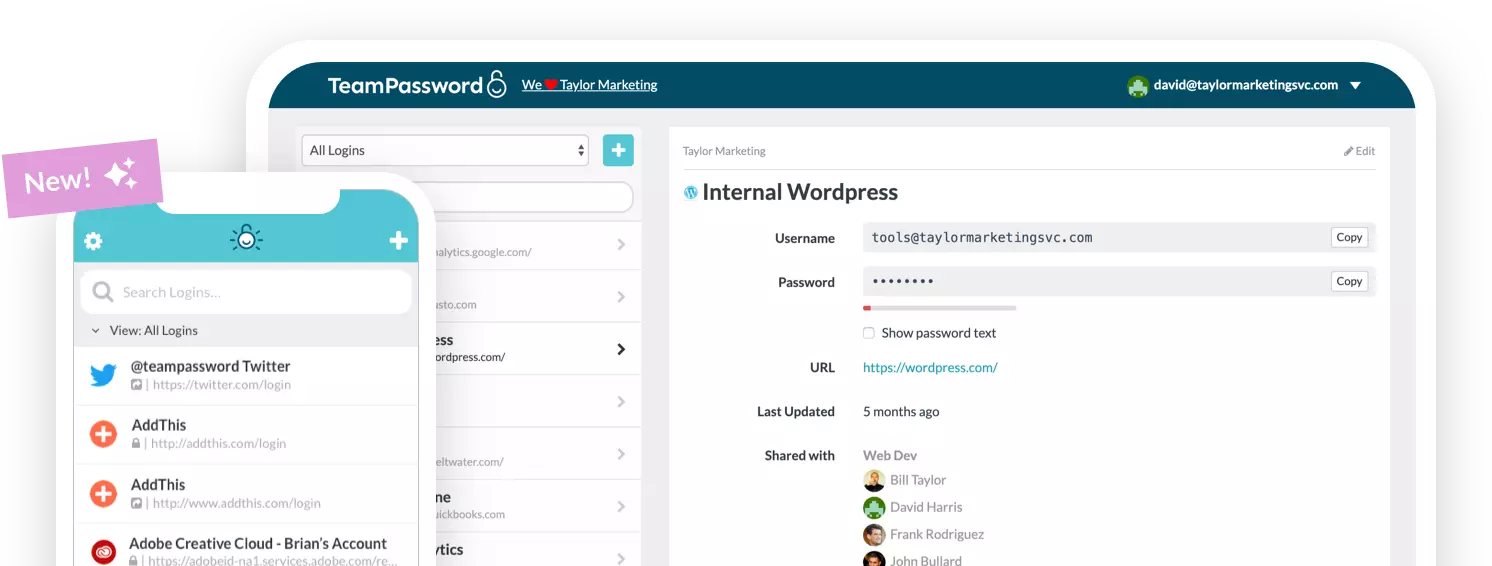
A password manager is a necessary tool that enables users to utilize strong, unique passwords for private accounts without the need to remember them or write them down. However, choosing a password manager for small businesses is not the same as selecting one for personal use.
That’s because a personal password manager, while offering sufficient password security, is more or less also a tool for convenience. A password manager for small businesses offers additional features and benefits that can not only improve data security within the organization but also help teams be more productive and facilitate collaboration.
Why Your Small Business Can’t Afford to Ignore Password Security
Most employees are aware of password security best practices, but most employees don't follow the rules. Of course, the problem is that creating a unique password for each service and remembering them is challenging — especially when the passwords need to be changed on a regular basis! But, it only takes one weak link to compromise an entire network.
Password managers are essentially a password book that's locked with a master key that only the employee knows. Instead of remembering 147 different passwords (the average number for a small business team), they only have to remember a single password. The password manager handles the rest by recalling passwords and even auto-filling them in browsers.
In addition to managing passwords, password managers can easily generate random 20-character passwords on demand. Even with a fast hashing algorithm like MD5, a genuine 20-character password would take an enormous amount of time to crack using brute force methods (thousands of years). Passwords can even be customized to meet unique password requirements for various web services.
5 Essential Features of a Small Business Password Manager
To move from personal convenience to business-grade security, your password manager must enforce safety without stalling your team’s workflow. Look for these five pillars of a professional solution:
1. Low-Friction User Experience
Security only works if your team actually adopts it. If a tool requires extensive onboarding or complex manuals, adoption will fail. Seek an intuitive interface that feels like a productivity gain rather than a compliance chore.
2. Zero-Knowledge Security & MFA
Your provider should never have access to your "Master Key." Demand AES 256-bit encryption where data is decrypted locally on your device. Furthermore, Multi-Factor Authentication (MFA) via a dedicated authenticator app is a non-negotiable defense against compromised master passwords.
3. Granular Admin Controls & Auditing
Visibility is the cornerstone of authority. Admins must have access to real-time activity logs and security reports. You should be able to see who accessed which login and when, allowing you to spot anomalies or stale credentials before they become a liability.
4. Cross-Platform Sync & Browser Integration
To maintain a high velocity of work, credentials must follow the user. Choose a solution that offers seamless sync across mobile and desktop, paired with robust browser extensions. One-click logins eliminate the "copy-paste" fatigue that leads to employees bypassing security protocols.
5. Encrypted Team Collaboration
Sharing passwords via Slack, email, or spreadsheets creates massive security leaks. A professional manager allows teams to share access within a fully encrypted environment, ensuring that even when credentials change hands, they never leave the protected vault.
Business vs. Personal Password Managers
Password managers are a great way to manage each employee's passwords, but they fall short when it comes to sharing passwords between employees. While it's possible to simply share a password and have each employee save it, the process breaks down when the password is changed and that change needs to persist across all of the employees that use it.
Many companies use password-protected spreadsheets to share passwords, or even worse, Google Sheets that are protected only by an obscure URL. If an attacker gains access, these spreadsheets can quickly turn into a massive data breach impacting every online service on the list. Therefore, these solutions should be avoided at all costs.
7 Top Password Managers for Small Business
#1. TeamPassword
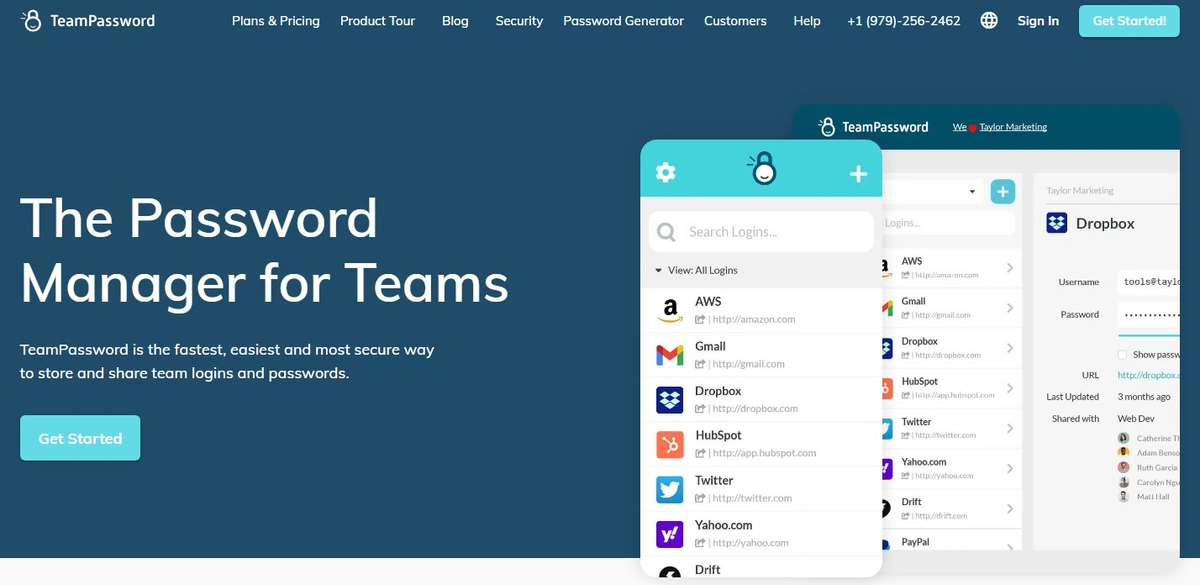
For agencies managing client passwords and small businesses enhancing departmental security, TeamPassword offers a focused, user-friendly solution. Navigate with ease, streamline daily tasks, and onboard new members quickly thanks to its intuitive design.
TeamPassword delivers essential security features, including enforceable 2FA, an integrated TOTP authenticator for simplified logins, unlimited records and groups for comprehensive organization, and activity logs for complete oversight.
TeamPassword pricing: Standard plan at $2.41/user/month or the Enterprise plan for $5.25/user/month.
TeamPassword Features
- Accessible on all devices: Log in once to access your tools and services from any device.
- Effortless adoption: The user-friendly interface allows you to utilize all features without any hassle.
- Secure password sharing: Share passwords with team members or groups with ease and revoke access as needed.
- Integrated TOTP Authenticator
- Different user roles for Role-based Access Control
- AES 256-bit encryption, zero knowledge architecture
- Enforceable 2FA
#2. Dashlane
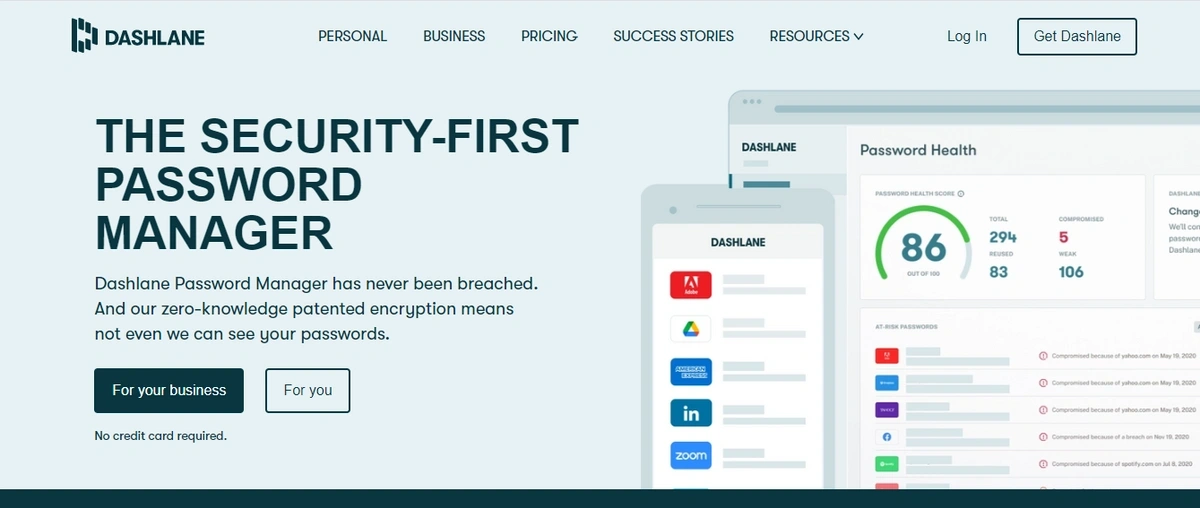
Dashlane positions itself as a comprehensive, "all-in-one" security suite for organizations that want to solve multiple challenges with a single tool. Its narrative is built on a spotless breach record and a patented zero-knowledge architecture that ensures your data is only ever decrypted locally on your own devices. For the business owner, the story here is one of high-trust and high-convenience, particularly for teams that struggle with the friction of personal versus professional accounts. Dashlane’s "Smart Spaces" feature handles this beautifully, keeping work and personal credentials strictly separate while maintaining employee privacy. While it sits at a higher price point, it justifies the cost by bundling a VPN and dark web monitoring into the same subscription.
Dashlane Features:
- Zero-Knowledge Architecture: Patented security ensures only the user can access their stored data.
- Smart Spaces™: Maintains work-life privacy by separating business and personal credentials within one app.
- Integrated VPN: Provides encrypted internet connections for remote and traveling employees.
- Dark Web Monitoring: Continuously scans for compromised credentials and alerts admins to potential threats.
- SSO & SCIM Integration: Automates user onboarding and offboarding through existing identity providers.
- Phishing Protection: Offers real-time alerts to prevent users from entering credentials on suspicious sites.
Dashlane is rarely the cheapest option on the market, but it is one of the most feature-complete. A small team of up to ten users can get started for approximately $20 per month, while growing organizations usually opt for the business-tier licensing at roughly $8 per seat.
#3. LastPass
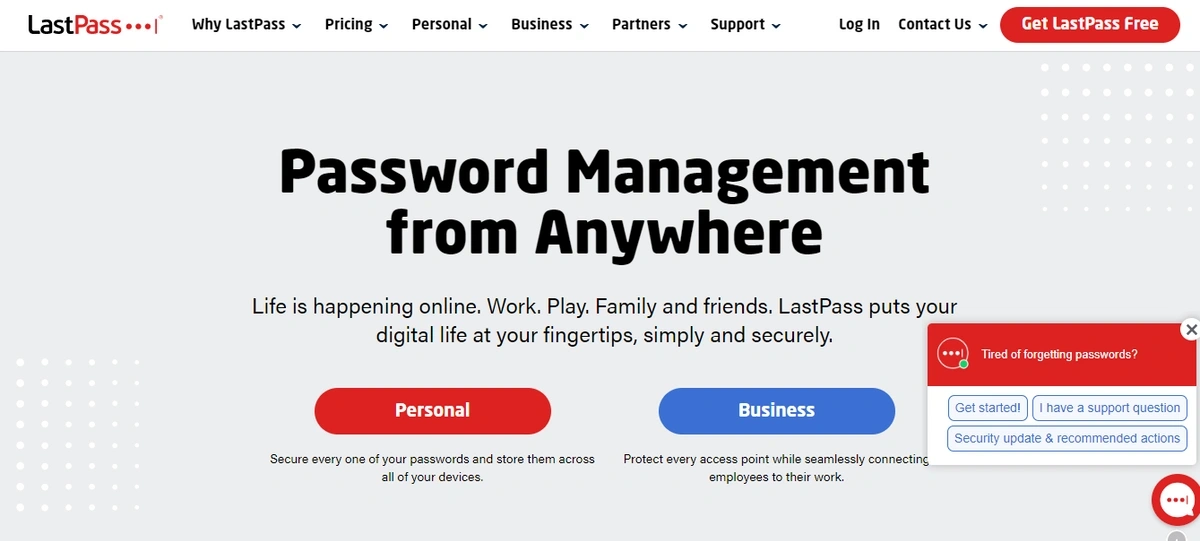
As one of the most established names in the industry, LastPass tells a story of ubiquity and familiarity. It is designed for large teams that need a tool that works across every possible device and browser. While it has faced scrutiny following past security incidents, it has responded by modernizing its infrastructure and leaning into "passwordless" technology, allowing users to access their vaults via biometrics or mobile authenticator apps rather than a typed master password.
LastPass Features:
- Shared Folders: Simplifies group credential management with flexible permissions.
- MFA Options: Supports a wide range of hardware keys and biometric logins.
- Passwordless Access: Log into your vault using the LastPass Authenticator app.
- Policy Enforcement: Admins can mandate master password complexity and 2FA.
- Directory Integration: Syncs with Azure AD, Okta, and Google Workspace for easy setup.
LastPass offers tiered pricing for businesses: an annual plan for teams is priced at $4.25 per user/month (often with a user limit, such as 50 users or less, for this tier). For larger teams exceeding this cap, the cost typically increases, for example, to around $7.00 per user/month when billed annually. Optional add-ons for advanced features are also available at an additional cost.
#4. Keeper
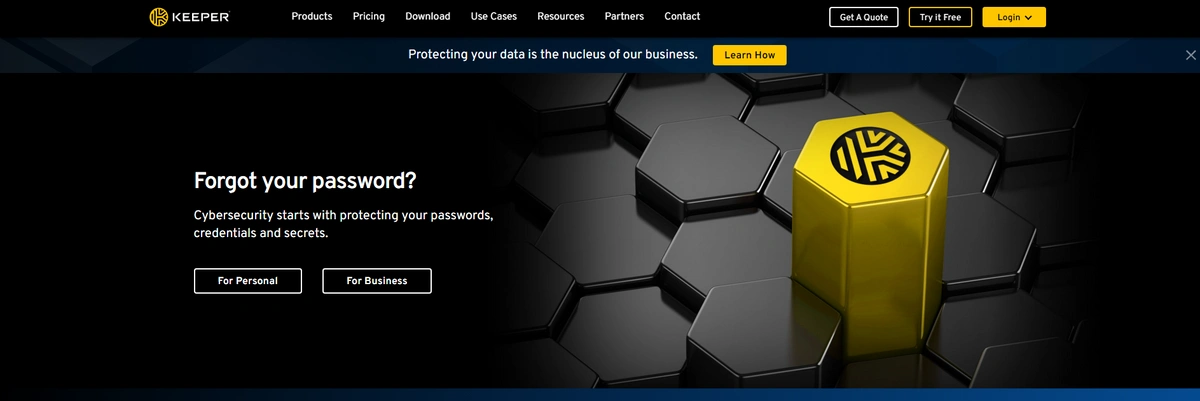
Keeper is built for organizations where compliance and infrastructure security are the top priorities. It positions itself as a "Secrets Manager," meaning it handles not just web logins, but also API keys, database credentials, and server certificates. For a buyer in a regulated industry like finance or healthcare, Keeper’s story is about total visibility and meeting strict SOC 2 or HIPAA requirements through detailed reporting and zero-trust architecture.
Keeper Features:
- Zero-Trust Security: Ensures that no one, including Keeper, can access your data.
- Secrets Manager: Securely manages infrastructure keys and developer secrets.
- BreachWatch: Scans the dark web for stolen credentials related to your domain.
- Advanced Reporting: Provides full audit trails and compliance-ready event logs.
- 24/7 Support: Dedicated onboarding and support for enterprise-scale teams.
Keeper provides flexible pricing options: their Business Starter plan for teams of 5-10 users is $2.00 per user per month, while the standard Business plan for teams exceeding five users is $3.75 per user per month. Custom solutions are available for enterprise-scale requirements.
#5. 1Password
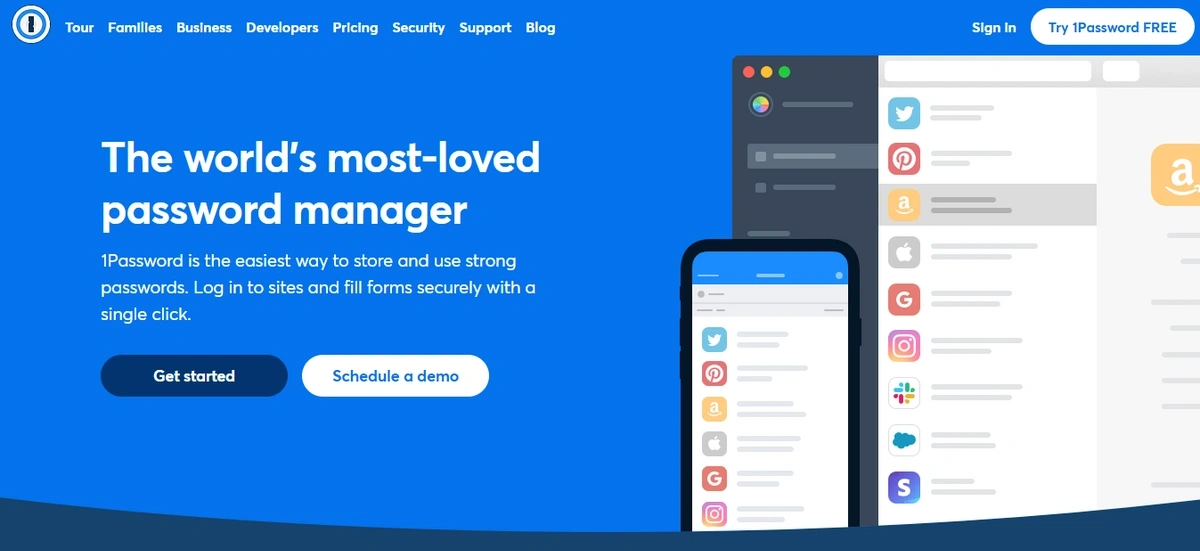
If your team is highly technical or handles sensitive intellectual property, 1Password is the "gold standard." It goes beyond a simple master password by requiring a unique "Secret Key" that stays on your device, making it mathematically impossible for outsiders to decrypt your vault. Its narrative is one of deep, granular control, featuring specialized tools like "Travel Mode" that temporarily wipes sensitive data from devices before you cross international borders.
1Password Features:
- Secret Key Architecture: Adds a unique second layer of encryption for every account.
- Watchtower: Proactively identifies weak passwords and known data breaches.
- Travel Mode: Removes sensitive vaults from devices while traveling for extra privacy.
- Developer Tools: Includes a Command-Line Interface (CLI) for technical workflows.
- Granular Vaults: Easily organize and tag credentials for different departments or clients.
1Password offers an annual business plan for $19.95 per month (this typically covers a small team, e.g., up to 10 members – it's best to verify the exact user count for this flat fee). Alternatively, their per-user Business plan costs $7.99 per user/month with annual billing, scaling for larger teams.
#6. KeePass
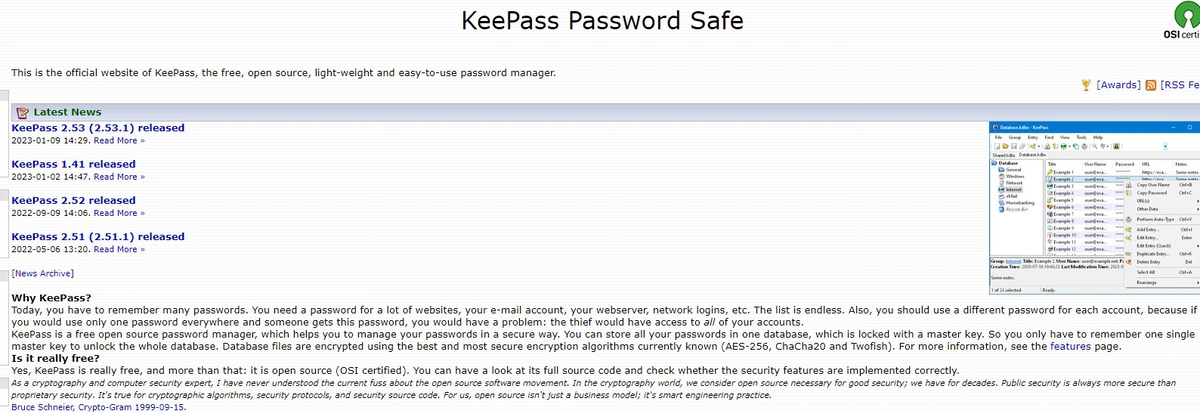
If you can put up with its interface and have the technical knowledge to set it up, KeePass provides a robust set of features while remaining free and open-source.
With KeePass, users can take advantage of a powerful password generator and form autofill functionality, as well as the capability to import logins from web browsers. While it may require a slightly higher level of technical expertise compared to other password managers, KeePass stands out as an excellent choice, particularly for teams seeking a cost-effective password management solution.
One of the standout qualities of KeePass lies in its highly customizable functionality. Users can configure the settings of KeePass to align with their specific requirements. Furthermore, KeePass securely stores all passwords locally on the user's device, granting complete control over personal data. By adopting local storage, KeePass ensures that user data is not stored on any third-party servers, thereby enhancing overall security.
KeePass features:
- Open-source: Verify the correct implementation of security features.
- Multiple user keys: Employ a master password or key files to decrypt the database, bolstering security.
- Flexible import/export: Seamlessly import data from various file formats and utilize the KeePass database with other applications.
#7. Enpass
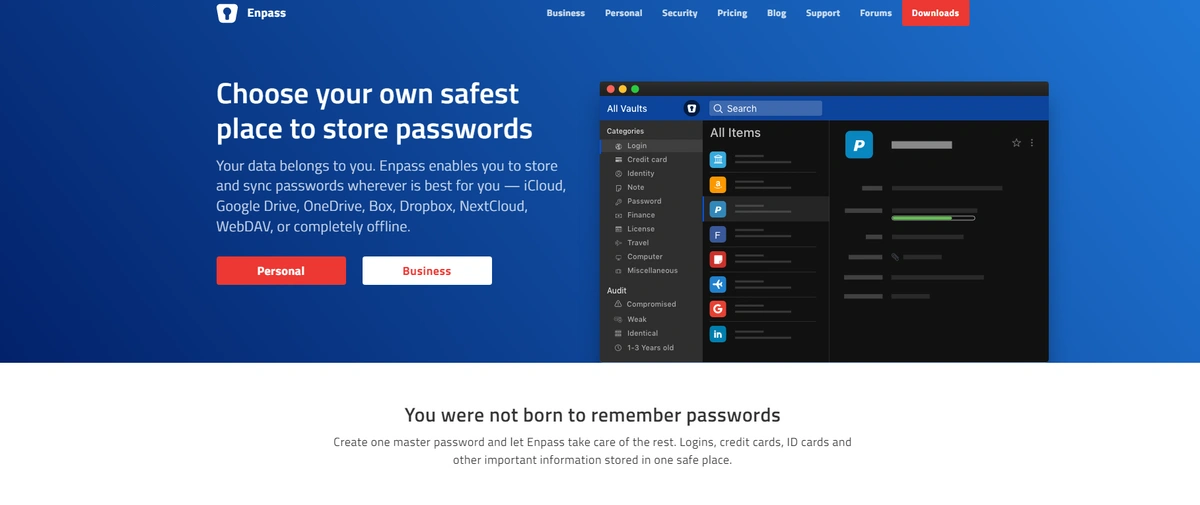
Enpass offers a hybrid "offline-first" approach that appeals to privacy-conscious small businesses. Unlike most competitors, Enpass does not store your passwords on its own servers. Instead, it lets you choose where to sync your data—using your own business cloud accounts like OneDrive, Dropbox, or Google Drive. This allows you to maintain a modern, synced experience without giving a password company "custody" of your encrypted database.
Enpass Features:
- Choose Your Cloud: Sync data through your existing business storage providers.
- Offline Access: Functions perfectly without an internet connection.
- Multiple Vaults: Separate client, project, or personal passwords with ease.
- One-Time Purchase: Offers a desktop license model that avoids recurring subscriptions.
- Audit Tools: Identifies weak, old, or compromised passwords within your database.
Enpass pricing can be found here: https://www.enpass.io/pricing/
Secure Your Team's Passwords With TeamPassword
While the designers of TeamPassword place a strong focus on security, they also want to create a password manager for small businesses that's easy to use, fast, and ideal for teams of any size.
TeamPassword makes it easier than ever to not only create strong, unique passwords for each private account but also to keep all logins safe and in sync. This ensures that all team member can quickly and easily access an account whenever they need to, from any location.
Being able to access data and accounts with ease prevents the frustration and loss of productivity that occurs when team members are locked out of an account or can’t remember a password. With a shared password manager like TeamPassword, you can eliminate downtime and keep projects moving on schedule.
The Google Chrome browser extension also improves efficiency via cloud-based platform, giving users seamless, 1-click access to logins.
TeamPassword was designed for small businesses and eliminates all the unnecessary features that are often found on personal password managers but not much use to small businesses. This helps to keep costs down, making it a cost-effective solution for small businesses in any industry. There are a range of pricing plans to choose from depending on the size of your teams, ensuring you don’t pay extra for what you don’t need.
Small Business Password Management FAQs
What Is the Best Way to Manage Passwords?
Password managers are widely regarded as the best way to manage passwords effectively. These secure tools store and encrypt your passwords in a centralized vault, allowing you to generate strong, unique passwords for each online account without the burden of memorization. With a password manager, you only need to remember a master password to access your vault. This not only enhances security but also saves time and effort. Password managers often offer additional features like autofill, password sharing, and dark web monitoring, further bolstering your online security. By using a reputable password manager, you can streamline password management, strengthen your accounts, and significantly reduce the risks associated with weak or reused passwords.
Are Password Managers Secure?
Password managers are generally considered to be a secure solution for managing passwords. They employ strong encryption algorithms to protect your sensitive data, making it extremely difficult for hackers to access your passwords. Additionally, password managers often utilize advanced security measures such as two-factor authentication and secure password sharing protocols.
However, like any technology, there are potential risks to consider. One potential vulnerability is if the master password is weak or compromised, as it grants access to the entire password vault. It is crucial to choose a strong, unique master password and avoid reusing it elsewhere.
Another risk is the possibility of a security breach at the password manager's end, although reputable providers employ stringent security measures to mitigate this risk. Overall, with proper security practices such as strong master passwords and regularly updating the password manager software, the benefits of using a password manager for improved password security outweigh the potential risks.
How Much Should You Pay for a Password Manager?
The cost of a password manager varies depending on the features and level of service offered. However, it's important to note that investing in a reliable and secure password manager is crucial for safeguarding your digital identity. While there are free options available, premium password managers typically provide enhanced security features, cross-device synchronization, and priority customer support. Prices can range from a few dollars per month to an annual subscription. It's advisable to assess your specific needs, consider the features provided, and choose a password manager that aligns with your budget and security requirements. Remember, the value of protecting your sensitive information and simplifying password management far outweighs the cost associated with a reputable password manager.
How Do You Choose the Right Password Manager?
The seven password managers we presented each have strengths and weaknesses. We suggest making a list of must-have and nice-to-have features. Do you need advanced admin insights to track user activity? Is your primary concern that your team won't use a password manager if it's too complex? Is there a specific SSO integration you require? Make your list and do the research. Most password managers offer a free trial - no credit card required. Take advantage of the free trials and test things out with your team. Only you can choose the perfect password manager for your situation.