What Are Passwordless Logins and How Do They Work?

Passwordless logins allow users to securely access apps, devices, or networks without entering a traditional password.
If that sounds futuristic, it’s not. You’re probably already using passwordless authentication every day. Every time you unlock your phone with Face ID or your fingerprint, you’re using it.
Instead of relying on people to create, remember, and protect complex passwords—which, realistically, get reused or written down—passwordless systems are built around how humans actually behave. The result is simple: stronger security with less friction.
While biometrics often get the spotlight, the real transformation in passwordless technology is happening behind the scenes. Innovations like passkeys, public-key cryptography, and modern authentication frameworks are redefining how we think about identity and access.
In this guide, we’ll break down:
- What passwordless authentication actually is
- How it works under the hood
- Why passkeys are a game-changer
- The pros and cons of going passwordless
- And how to implement a practical, modern security strategy
Table of Contents
The Long Road to Killing the Password
The idea of replacing passwords isn’t new—it’s been a goal for decades.
Back in 2004, Bill Gates famously predicted that passwords would soon become obsolete because they simply didn’t meet modern security challenges. In 2011, IBM went even further, suggesting that passwords would disappear within five years.
By the early 2010s, security experts and major tech companies were already sounding the alarm. Google’s security team publicly acknowledged that passwords were no longer sufficient to keep users safe. Even journalists who experienced firsthand account breaches declared “the age of the password has come to an end.”
And yet, here we are.
Passwords didn’t disappear—but not because they’re good. They stuck around because they’re easy to implement and universally understood.
The problem is that they’re also:
- Easy to guess
- Easy to reuse
- Easy to steal
- Easy to phish
In other words, passwords have remained the single biggest vulnerability in modern security systems.
What’s changed in recent years isn’t the problem—it’s the infrastructure. With the rise of cloud ecosystems and cross-device authentication, we finally have the foundation needed to move beyond passwords in a meaningful way.
The Rise of Passkeys: The Biggest Shift in Passwordless Tech
If there’s one innovation driving the passwordless movement forward today, it’s passkeys.
Passkeys are a modern authentication method built on public-key cryptography and standardized through frameworks like FIDO2 and WebAuthn. They allow users to log in using the same method they use to unlock their device—such as a fingerprint, facial recognition, or device PIN.
Here’s what makes passkeys fundamentally different from passwords:
1. They’re phishing-resistant
There’s no password to steal, no code to intercept, and nothing a user can accidentally give away. Authentication happens locally on the device.
2. They’re unique by design
Every login creates a new cryptographic key pair. Unlike passwords, nothing is reused across accounts.
3. They’re device-bound (but flexible)
Passkeys are tied to your device but can sync across ecosystems like Apple, Google, and Microsoft—solving one of the biggest pain points of earlier passwordless systems.
4. They eliminate shared secrets
Traditional authentication relies on shared secrets (passwords). Passkeys don’t. The server never sees or stores anything that could be reused in an attack.
This combination of security, usability, and scalability is why passkeys are widely considered the future of authentication.
If you want a deeper dive into how passkeys work and why they matter, check out this comprehensive article:
https://teampassword.com/blog/passkey-technology
How Does Passwordless Authentication Work?
Passwordless systems use Public-Key Cryptography. This involves two separate keys that work like a digital lock and key:
- The Public Key: Stored on the server (the website or app you’re visiting). It’s not a secret.
- The Private Key: Stored securely on your device (phone, laptop, or hardware key). This is a secret and never leaves your device.
The Two Pillars of Authentication
| Factor Type | Examples |
|---|---|
| Ownership (Something you have) | Smartphones, hardware security keys (YubiKeys), or a specific network address. |
| Inherence (Something you are) | Fingerprints, facial recognition, retina scans, or behavioral patterns. |
Passwordless vs. MFA: What’s the difference?
Don't confuse the two. MFA often includes a password (e.g., Password + SMS code). Passwordless MFA replaces that first step with something else, like a fingerprint scan followed by a push notification. No typing required.
Passwordless vs MFA vs SSO: What’s the Difference?
These terms are often used interchangeably, but they serve different roles in a modern security stack.
Multi-Factor Authentication (MFA)
MFA requires multiple forms of verification. Traditionally, this includes a password plus a second factor (like a one-time code).
Passwordless MFA
This replaces the password entirely. For example:
- Step 1: Fingerprint or face scan
- Step 2: Device confirmation or OTP
No password involved.
Single Sign-On (SSO)
SSO allows users to log in once and gain access to multiple systems without re-authenticating.
How they work together
Modern authentication isn’t about choosing one—it’s about combining them.
A typical secure flow might look like this:
- Log in with a passkey (passwordless)
- Verify identity with biometric authentication (MFA)
- Access multiple tools through SSO
This layered approach delivers both high security and a seamless user experience.
The Pros and Cons of Passwordless Authentication
Advantages
Stronger security
Passwords are the primary entry point for attacks like phishing and credential stuffing. Removing them eliminates those risks entirely.
Better user experience
No more forgotten passwords, resets, or frustrating login flows.
Reduced IT workload
Fewer password reset requests, less policy enforcement, and less time spent managing credentials.
Improved visibility and control
Access is tied to devices and identities, making it easier to track and manage usage.
Scalability
The average user now manages hundreds of accounts. Passwordless systems scale without increasing cognitive load.
Disadvantages
Implementation costs
Rolling out passwordless systems—especially with hardware tokens—can require upfront investment.
Training and adoption
Users and IT teams need time to adjust to new workflows.
Device dependency
If a user loses access to their device, recovery processes become critical.
Ecosystem limitations
Not every application supports passwordless authentication yet, especially older systems.
Why Most Organizations Are Going Hybrid
Despite the advantages, very few organizations are fully passwordless today—and that’s okay.
In reality, most businesses operate in a mixed environment where modern apps supporting passkeys or SSO must coexist with legacy systems and irreplaceable shared accounts that still rely on traditional passwords. This friction is exactly why the most effective strategy today is hybrid security.
A practical implementation starts by deploying passkeys and passwordless authentication wherever possible while using SSO to centralize access across the organization. To round out the defense, you should enforce MFA for an extra layer of protection and utilize a secure password manager to catch everything else that hasn’t yet made the leap to modern standards.
Where TeamPassword Fits In
Even as we move toward a passwordless future, passwords aren’t disappearing overnight.
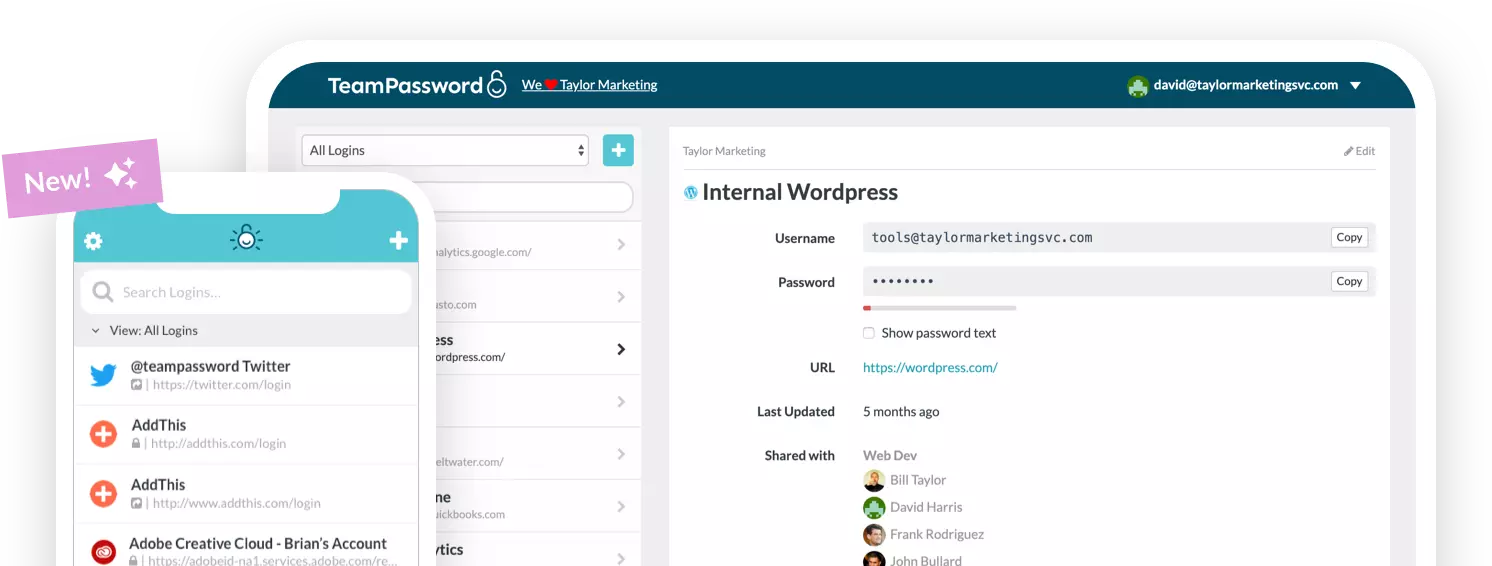
Most teams still manage anywhere from dozens to several thousand services and systems that require passwords. Many tools do not yet support passkeys, and even if the passkey can be "shared" and used by multiple people on multiple devices, this creates a security concern when it comes time to revoke someone's access to a service. With passwords, you can kick someone out of your password manager and update the service's password - problem solved.
Thus, a password manager remains a crucial functions in teams of all sizes. TeamPassword's lucid interface and pricing model appeal to small businesses and non-profits, though they also serve large corporations who are focused on ease-of-use.
A few of TeamPassword's core features are as follows:
- Segment passwords into Groups (usually based on department or client) so members only have access to what they need
- Activity log to track how credentials are being access or changed
- Easy onboarding and offboarding
- Integrated TOTP authenticator (no more trying to share time-based codes with teammates)
- Two per-user pricing plans, available as monthly or yearly contracts
Bringing It All Together with SSO
To make things even more seamless, TeamPassword now supports Microsoft Entra ID SSO.
This allows your team to:
- Log in using existing Microsoft credentials
- Centralize authentication across tools
- Reduce password fatigue even further
- Strengthen security with enterprise-grade identity controls
You can learn how to configure it here:
https://help.teampassword.com/en/articles/13015534-configuring-enterprise-sso-with-entra-id
More SSO integrations are in the works.
The Future of Authentication
Passwordless authentication is actively reshaping how we secure systems.
Passkeys, in particular, represent a major turning point. For the first time, we have a solution that eliminates passwords entirely while improving the user experience, scaling seamlessly across platforms, and significantly reducing potential attack surfaces.
However, this transition won’t happen overnight. For the foreseeable future, organizations will need to operate in both worlds—adopting passwordless authentication wherever it’s supported, while still securing traditional passwords where they remain necessary.
The shift to passwordless authentication stands as one of the most important developments in modern cybersecurity. But success doesn’t come from going all-in overnight; it comes from adopting the right mix of technologies at the right time.
You need a solution that:
- Supports where authentication is going
- Protects what still exists
TeamPassword gives you both.
Posts Recomendados
How to Make a Good Username | Create a Unique and Secure Username
See the best way to come up with a new username. We break down types of usernames, why ...
The 5 Best Password Managers for Nonprofits (2026 Review)
Nonprofits have unique needs in software, from lower budgets to less tech-savvy staff or no dedicated IT staff. ...
Top 10 cybersecurity threats for nonprofits (and how to prevent them)
Here’s what you need to know about cybersecurity threats for nonprofits, the top risks they face, and practical ...
Cybersecurity for Nonprofits: Keeping Your Nonprofit Secure
Cybersecurity is critical for all organizations, including nonprofits. Learn more in this guide about cybersecurity for nonprofits.
Fortaleça a segurança das suas senhas
O melhor software para gerar e gerenciar suas senhas corretamente.